An interview with an athlete who has truly seen it all.

I started following Geas last October, during their first EuroCup game against Beşiktaş. Honestly, I went mostly to see Temi Fagbenle—she’d just finished her WNBA season with the Indiana Fever—and Nika Mühl, the Seattle rookie from UConn. But a few days before tip-off, Mühl tore her ACL. Brutal. For her, of course. But yeah, a little for me too.
I’ll admit it: I barely knew anything about this team. I knew they were from Sesto San Giovanni, just North of Milan, but they played their EuroCup games in Castellanza and the league games in Cinisello. That alone had me confused. They got beat pretty soundly by Beşiktaş—not a terrible performance, but there wasn’t much of a fight.
I went to their next league game too, which they played back in Sesto. They lost to Derthona after leading almost the entire game, with a free throw three seconds from the buzzer. “Am I the curse?”, I wondered.
So I went to the next EuroCup game, mostly to find out if it really was my fault. They won that one—against Benfica. Thank God, I thought.
That’s when I started really studying the players. Their backgrounds. Where they’d played. Which colleges, if any. I uncovered a whole microcosm of interesting stories.
There’s Anna Makurat, who played two seasons at UConn under Geno Auriemma, went back to Poland, then Sassari, Venice, and Geas. And now? She’s in Phoenix, chasing a WNBA spot with the Mercury during the wild gauntlet of training camp.
Then there’s Gina Conti: born in Ohio, played for Wake Forest and UCLA before making the leap to Milan—and to the Italian national team, where her dad’s roots run.
Tinara Moore. She came out of Central Michigan University — her home state’s college — before heading to Europe via Spain. This season, she gave everything for Geas, leading the team in minutes played, points, rebounds, and blocks.
Among a strong core of Italian players, — including national team members Valeria Trucco and Anastasia Conte, veteran sharpshooter Laura Spreafico, and the former Bologna duo Alessandra Orsili and Beatrice Barberis, who landed in Sesto after Virtus shut down its women’s team — the longest-tenured player at Geas is Jazmon Gwathmey. Born in Virginia, she played for the Puerto Rican national team and traveled across three continents before making her way to Europe.
“The call from Geas came right after the pandemic started,” Gwathmey recalls. “It was a tough time. Teams were bleeding money, sponsors were pulling out. The moment they reached out, I said yes right away.”
“I didn’t care what the hell they were offering. I just needed a job, and I wanted to get out of the house. And so when I came here, it was difficult, not only for myself, it was difficult for everybody. But the club made it bearable. They did things for me I didn’t even have to ask for. And that made it much easier to put myself out there during a difficult time.”
“From the very beginning, I felt good, and that’s why I decided to stay and accept every contract extension they offered.”
“Every year, I was surprised when Coach Cinzia [Zanotti] asked me to stay. That doesn’t happen in this business—players bounce around constantly. Every time, I’d laugh and ask, ‘You still want me?’ And yeah, I had better offers elsewhere. But for me, feeling good is more important than money. And at Geas, I always felt at home.”
April 6th, the final game of Geas season. Game 2 of the playoffs against Campobasso. A win-or-go-home situation. Just like so many other games this season (at least since I started showing up to the arena), Geas played well in Game 1, led for most of it… and then collapsed at the buzzer.
Of course I thought about how many games they could have won if I hadn’t brought my bad luck to Cinisello, but I’ll keep that answer to myself.
In the fourth quarter, the outcome was already clear. Even the crowd had settled into resignation. And then Makurat went down, clutching her knee. The one thing left that could still go wrong—a serious injury to the player on the brink of a career-defining opportunity.
Fortunately, she got up. And right now, she’s in Phoenix, trying to earn a spot in the post-Diana Taurasi era. But the bitterest part of that game wasn’t the blowout loss. It was Jazmon Gwathmey’s retirement.
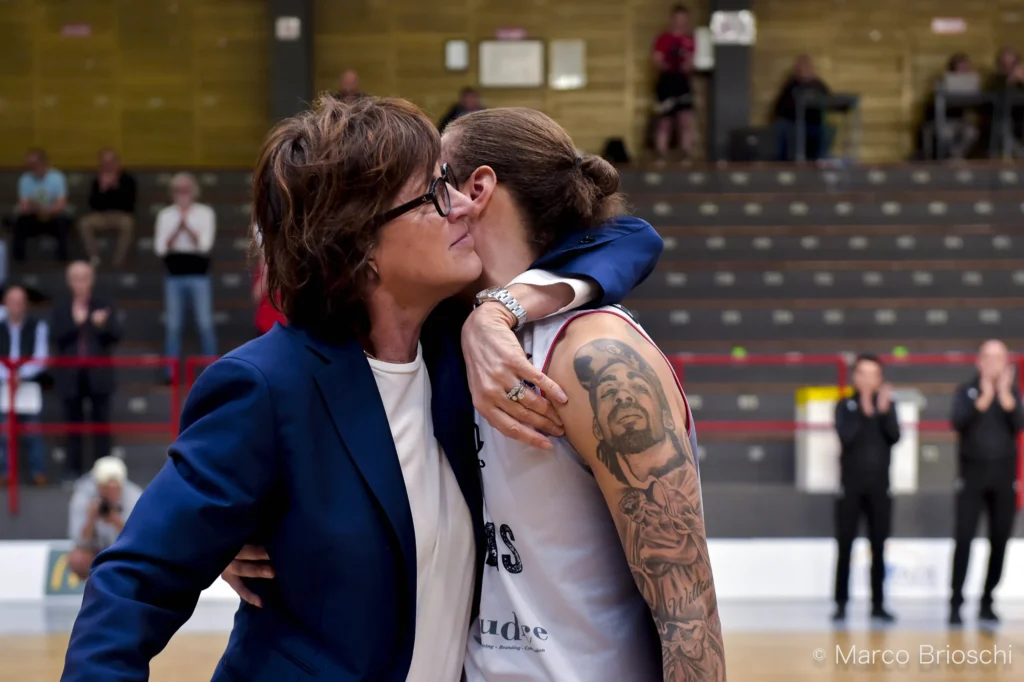
Right before tip-off, the team’s announcer Edy Cavallini paid tribute to the James Madison University guard, recalling all her experiences, the titles she won throughout her career, and her participation in the Tokyo Olympics with the national team, as Coach Zanotti handed her the number 24 jersey.
After traveling three-quarters of the world, she found her balance in northern Milan: a wife (Ashley Ravelli, also a former basketball player), a home, and two French bulldogs.
Draft Night
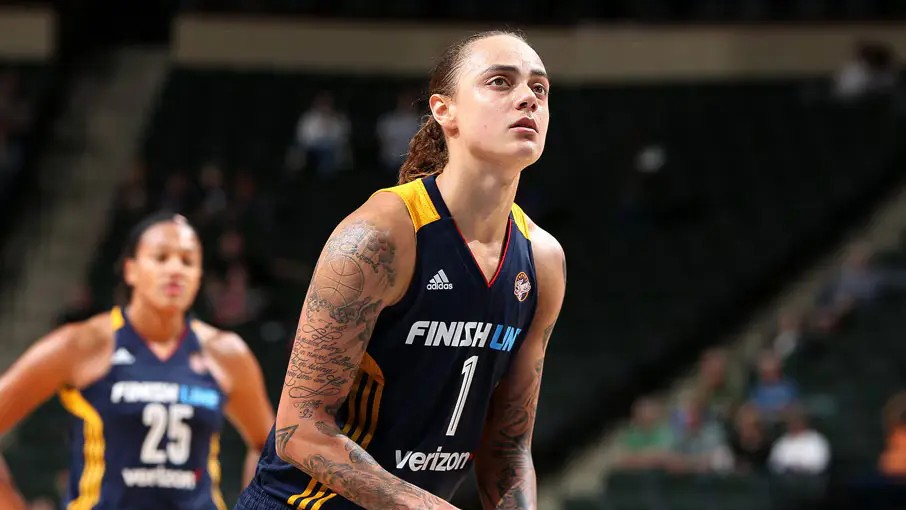
The 2025 WNBA Draft on Monday, April 14, which saw Geno Auriemma’s UConn Huskies dominate the spotlight—starting with Paige Bueckers at No. 1—brought back memories for Gwathmey of her own draft in 2016, when the top three picks all came from East Hartford’s college.
And as she shared the behind-the-scenes story with me, it helped me understand one of the craziest events – from a European perspective – in American sports.
“The only contact I had with pro basketball before my draft was the WNBA combine, a couple weeks earlier. It’s for players outside the spotlight to show what they can do in front of coaches and GMs,” she says. “I did fairly well. I got some interest. But that was it.”
“The night of the draft, I was at my college’s end-of-season dinner. Toward the end, they projected the live broadcast onto the screen. I was watching casually when—boom—pick 14: my name. Minnesota. That was Maya Moore’s team. Seimone Augustus’s. I thought, ‘No way.’”
“Then my agent [Ticha Penicheiro] messaged me. ‘You’re not going to Minnesota—they picked you for a trade.’ I was on an emotional rollercoaster. Up, down, spinning. She told me I was going to San Antonio. That made more sense. I’d actually spoken with their coach.”
“A week later, I was on a plane to Texas.”
What followed was a whirlwind. In the WNBA, rookies jump straight from college into camp. Two weeks to prove yourself, and then the coach and management choose the 12 players—out of the 16-18 invited—to make up the final roster.
“At first, I was scared. I kept messing up. During practice games—when it really counts—I wasn’t playing well. Until the coach took me aside and told me not to be afraid, and that they had picked me because, for them, I was an investment. Those words took some weight off my shoulders and gave me the motivation to really commit.”

“My rookie season ended up going pretty well. I started with just a few minutes off the bench. There were times when I’d be called into the game and the instructions would be: ‘Go in and guard Maya Moore.’ And I did my best. Over the course of the season, due to some injuries on the team, I moved into the starting lineup.”
“I found out on Twitter that I had been traded to Indiana.”
“After that season, I felt good. I’d earned my shot. I liked where I was. Then, during a preseason scrimmage in year two, just before I checked in, the GM told me: ‘Go change—you’re being traded.’ I was stunned.”
“I went home, called my agent. She didn’t know anything. Then I opened Twitter: ‘Jazmon Gwathmey has been traded to the Indiana Fever.’ I was so mad. But that’s the business.”
She actually liked her time in Indiana.
“I loved playing for Coach Pokey Chatman. Tamika Catchings was on staff. She was awesome. She took me under her wing. I started from the bench, like always, but worked my way into the rotation again. Then… they waived me in my second year. The Fever were rebuilding. I get it.”
“No hard feelings. But I decided I wouldn’t go back to the WNBA. The pressure’s just too much. People don’t realize—unless you’re a top pick, you’re constantly fighting for your spot. There are only 156 roster spots total. You can get cut at any time. Mentally, it’s exhausting.”
“I’ve had some offers for training camps over the years, but I always said no. The W is incredible, but you need to be extremely locked in and mentally tough enough to get through a whole season.”
The Diana Taurasi Experience
Gwathmey’s three years in the WNBA came with plenty of stress—but also a few stories worth telling, in retrospect. Like her first run-in with Diana Taurasi, who’s notorious for giving rookies a proper welcome and being a pain in the ass to pretty much everyone else.
“We were playing at home. My job was to guard Diana—easy enough, right?”
“I was coming off a pick-and-roll, she went to the right. I was trying to go over the screen and then, somehow—I still don’t know how—she hooked my arm and hit me with an uppercut before pulling up for the shot.”
“I hear a whistle. I think, ‘Good. Offensive foul’.
But then I saw my number. Somehow, it was on me.
She looked at me and just chuckled.”
“I remember this one time I had to guard Maya Moore, when I was with Indiana. I got interviewed at the end of the game. They’re like, ‘you did a really good job guarding her. What was your game plan going into it?'”
“I was just like: ‘What? She dropped 30!’ But in their eyes, I did a good job. So I was like, okay, cool.”
Another moment Gwathmey looks back on fondly is her first head-to-head with Seimone Augustus, one of her favorite players. “I really admired her. We were both tall guards with great control of the ball.”
“We immediately started going at it, talking smack, pushing each other — we were both super competitive.”
“At one point, the ref told us to knock it off, and Seimone basically cussed him out. I was like, ‘damn’, I looked at the ref, but he did nothing. So I turned to Seimone, kind of scared, and said, ‘Hey, I’m just a rookie. I don’t want any trouble.’ And she just laughed.”

Living out of a suitcase. I got really good at it
After her first year in the W, Gwathmey received a call from Canberra, 16 time zones away from home. Playing during the offseason is a necessity for roughly 90% of players. Money, as is well known, is a huge problem in women’s sports. For Gwathmey, it was especially an issue at the start, particularly in the United States.
During her college career, from 2012 to 2016, there was no NIL (Name, Image, and Likeness), the set of laws that allowed college athletes to earn from their image rights. This was only allowed nationwide and across all divisions starting in 2021, following the Supreme Court’s decision in NCAA v. Alston.
It was a revolution. Since then, many college athletes have signed multi-million dollar sponsorship deals while still in their freshman or sophomore years. But while for men this is often seen as a stepping stone before reaching major leagues (though not always, of course), it’s not exactly the same in women’s sports.
Rookie contracts in the WNBA for top picks are under $80,000 a year, before taxes. In the NBA, the top four picks make over $10 million in their first year alone. “When I entered the WNBA, the money issue was eye-opening for me. We were getting very little, and on top of that, we had to pay taxes in every state we played in. If we traveled to Los Angeles, we had to pay California taxes; when we went to Chicago, we had to pay Illinois taxes.”
“We Never Asked for Millions”
“I know people have been talking about the gender pay gap for a long time. The argument is that the NBA makes millions. We get that. But we’ve never asked for millions—we’ve only ever asked for realistic numbers.”
“In Australia, my first time playing abroad, I didn’t have to worry about taxes. The team took care of them. But then, of course, I still had to report my income to the IRS back in the U.S. and pay taxes all over again.”
“Money was the only reason I went—first to Australia, then to South Korea. I was getting paid well. But those were some of the toughest experiences of my life.”
“In Australia, the main problem was the 16-hour time difference from home. And because it was my first time outside the U.S. The season was short, but I just wanted to get out from there and come back home.”
But Korea was worse.
“I never felt like I belonged there. I lived in a hotel. That meant no cooking, no laundry, no normal routines. All the little things that help you feel at home. Nobody spoke English. I had to go everywhere with a translator and a teammate.”
“In the Korean league, there’s a high demand for American post players, since Korean players are generally not very tall. So I’d end up guarding WNBA-level bigs every game.”
And the workload?
“Insane. Two practices a day, every single day. Sometimes even after games. My body was breaking down. I started losing my hair. It was like my body was rejecting the whole experience. I was making good money, sure—but I earned every single penny.”
“I’d call my dad and tell him, ‘I can’t do this. I want to go home.’ Every time, he’d say: ‘Just hang in there. Look at your bank account.’”
“Every month, I’d tell myself, ‘This is the last one’. And somehow, that’s how I made it to the end of the season. But I promised myself: Never again. The money wasn’t worth sacrificing my mental and physical health.”
“That’s why, when I talk to younger players just coming out of college, I always tell them: Pick the place where you think you’ll feel okay. Not just the one offering the biggest paycheck.“
Gwathmey’s journey gives a real glimpse into the kind of life many hoopers find themselves living once they leave college. One thing I’ve always wondered is how you even begin to build a life when you’re constantly on the move, never quite sure how long you’ll stay in one place.
“Over time, I got pretty good at living out of a suitcase. I leaned on my personality, on knowing what I needed to stay grounded. Off the court, I’m super calm, quiet.”
“I got very comfortable being alone. I knew that after practice I could go home and decompress. I got used to not talking much. I’m totally different from how I am on the court.”
“My wife actually played against me before we started dating. She says she used to be scared of me.”
“I laugh at that, because I know it’s true.”
“I’m the kind of person who, when I’m out with a group, I’ll be totally fine just sitting quietly in the corner. I like to watch and take everything in. My first year at Geas, Bashaara Graves was there too. We got along really well because we were kind of the same. We could hang out on the couch for hours without saying a word and be completely happy.”
“Every team has its mix of personalities. Geas is no different.”
“Tinara Moore, for example—she’s a bit of both. She likes to be in her own space, but when she’s out in public, you can tell she feeds off people’s energy.”
“Our team had so many different types of people, each with their own quirks. But we all got along. We all loved each other.”
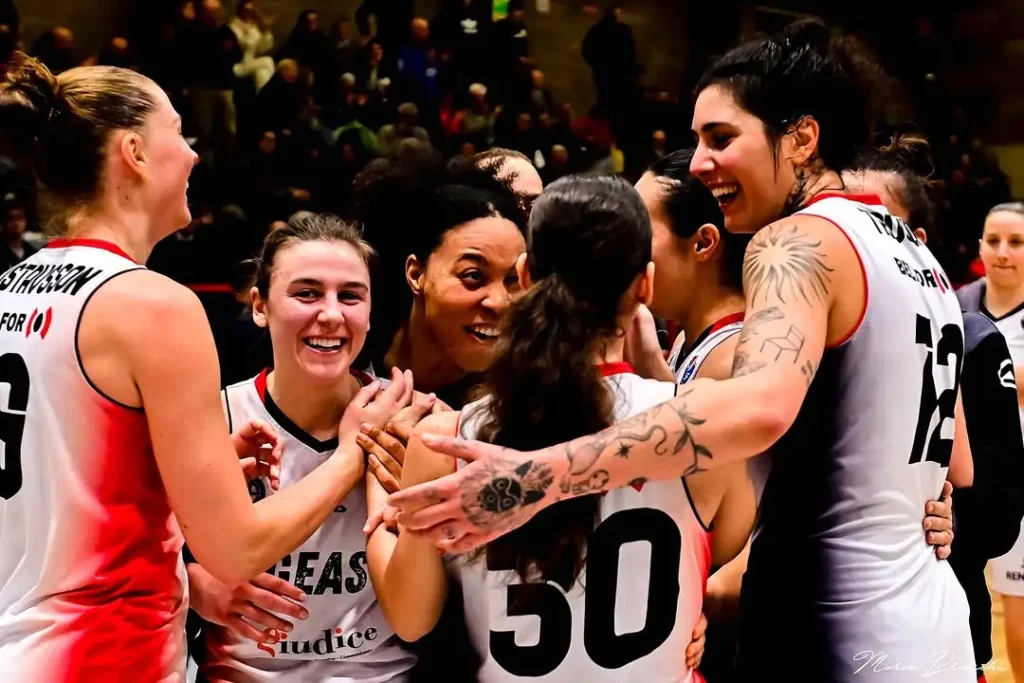
Gwathmey still struggles a bit to speak about Geas in the past tense. When she talks about the team, she still refers to it as “her team,” “her teammates.”
Ending a career at 32 must feel strange, after all.
Talking to her, I realized how much she has learned about herself and the world around her, and how much self-awareness she has gained. It seems like anything but a trivial accomplishment. But it’s also true that, in the span of a nine-year professional career, Gwathmey has lived multiple lives in one.
“My retirement day was tough. I got emotional. Not because I wanted to stop—I didn’t. I was forced to. My knees just couldn’t take it anymore. It took so much internal work to accept that.”
“What wore me down wasn’t just the games—it was the never stopping. Until 2022, I played for the Puerto Rican national team every summer. I flew across the world, played two tournaments each year, always as a starter. I even went to the Tokyo Olympics in 2021.”
“Every year, Coach Cinzia would beg me not to go. And finally, in 2023, I listened. That’s the year I tore my shoulder.”
“When she found out, she said, ‘Jaz, I’ll never ask you to skip national team again.’”
I’ll be honest: there’s a certain bittersweet feeling knowing she won’t step on the court again. Because she still has so much to give to this game.
But as she said, with a wry smile: “I’m not old. My knees are. They’re probably in their sixties.”
Her intention, however, is to stay in basketball. “I’d like to try some experience as an assistant coach, even at the youth level, to get my feet wet and to learn the coaching aspect of the game, and try to get the necessary qualifications to coach.”
I don’t know what path Gwathmey will take next. But one thing’s for sure: she’ll be back at PalaAllende, just a few meters off the court, cheering for her old teammates.
Let’s just hope she brings less bad luck than I do.

Photo by Marco Brioschi.